From the Ancient Canal Route to Navigable Access to the Sea — Exploring the Revival Path of Shaanxi's Waterway Transport
Shaanxi is located at the geometric center of the country and serves as an important node for the joint construction of the "Belt and Road Initiative," acting as a frontier for westward opening with key functions in connecting east and west as well as linking south and north. During the regional development process, Shaanxi's narrative of opening up has always unfolded toward the west and north. However, the Han River reminds people that a southern waterway also exists, allowing integration into the Yangtze River Economic Belt and making “access to the sea via rivers” a tangible option once again.
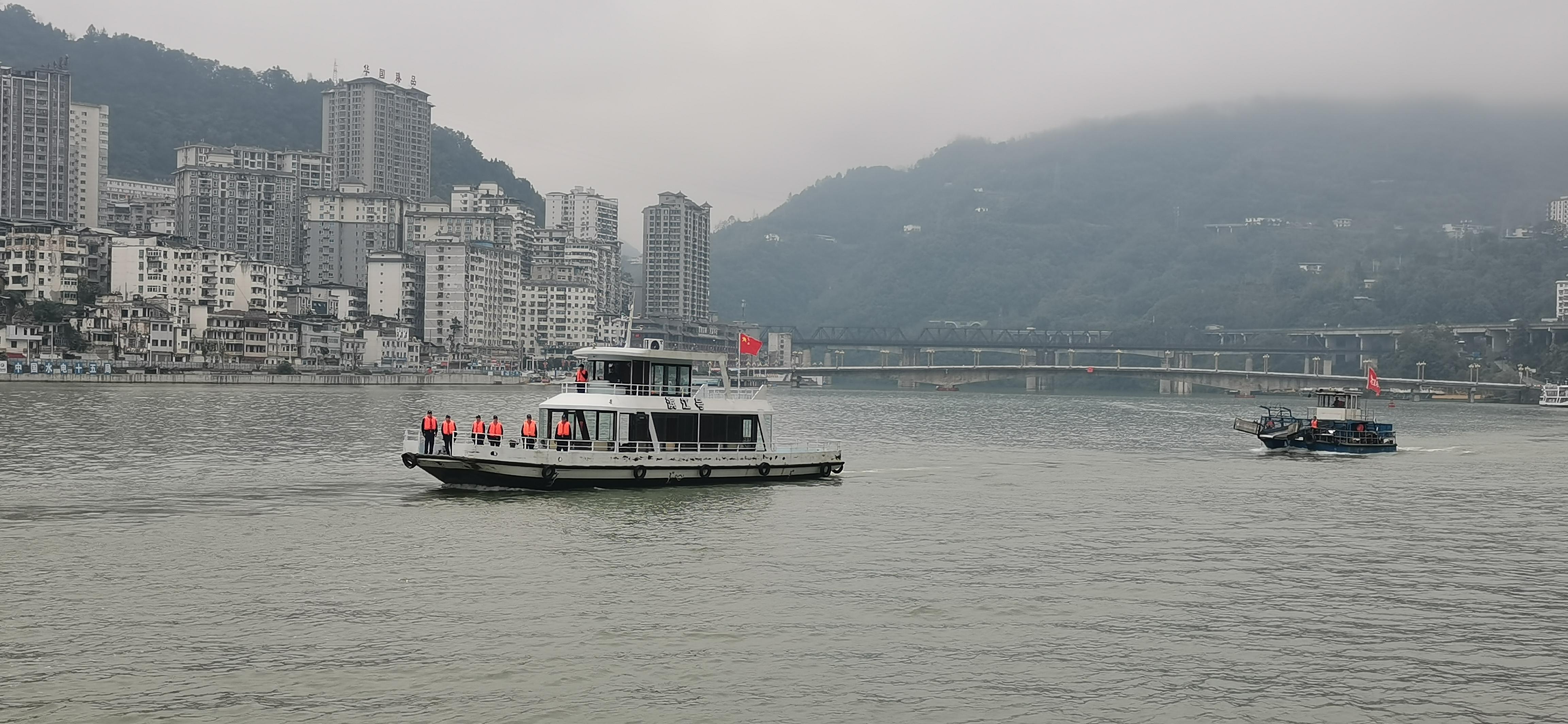
For a long time, road and rail transport have been Shaanxi’s primary modes for external cargo transportation. In comparison, Shaanxi's water transport has focused on “quickly addressing shortcomings.” On December 21, 2023, the Bahe-Danjiangkou section officially resumed navigation, with the first cargo ship carrying southern Shaanxi’s stone materials and plush toys heading toward Danjiangkou. This marked a substantive turning point: Shaanxi has begun to reassess the unique resource of the "Northwest region’s only national high-grade waterway."
From the formation of rail networks to high-speed rail densification, the expansion of aviation hubs, and the revival of the “golden waterway,” Shaanxi’s comprehensive transportation framework of road, rail, water, and air has reached maturity and established momentum, providing solid multidimensional support for creating a highland of inland reform and opening up.
The “Golden Waterway” Written into History
Shaanxi's water transport history is far deeper than many imagine. It is a record centering on the Han River’s “golden waterway,” encompassing its rise and fall. Its trajectory can be summarized as: originating in pre-Qin times, flourishing with caoyun (grain transportation via canals) and commerce during the Tang, Song, Ming, and Qing dynasties, declining due to the replacement by modern land transportation, and breaking completely during hydropower development from the absence of facilities for ship passage. Now, it is being reconnected with the resumption of navigation.
Written accounts of Han River navigation can be traced back to the Xia dynasty, mentioning the Liangzhou tributary route “floating on Qian, crossing over Mian.” After the Qin and Han periods, the Han River served as a strategic connection between the Yangtze and Yellow River basins for a long time. During the Sui and Tang dynasties, when the capital was established in Guanzhong, both the Wei River caoyun system and Han River transshipment carried equal importance. When taxes and tributes from Jianghuai were blocked at the Bian River, they were often rerouted through the Han River westward to Yangzhou and Liangzhou, then transported by land to Guanzhong; hence, the Han River was regarded as one of the lifelines for maintaining the capital region. In the Ming and Qing periods, with the development of the Qinba mountainous areas and increasing immigration, Han River navigation reached its peak. Ports along the river such as Ankang and Baihe were bustling with goods, and bulk commodities like tung oil, lacquer, and tea relied on the affordably priced downstream water transport. The Han River became the most critical logistics channel between southern Shaanxi and Hankou.
In modern times, as road and rail networks unfolded, traditional medium- and long-distance waterway transport was gradually replaced by land transport, leading to the decline of Han River navigation. The true cause of navigation disruption was the systematic absence of ship-passage facilities during the cascade hydropower development along the Han River since the late 1980s. Following the closure of the Ankang Huoshiyan hydropower station in 1989, navigation was interrupted. Key nodes such as Shiquan and Xihe did not construct navigation facilities, and the shipping facilities at Xunyang and Shuhe power stations were not built simultaneously with the power stations. The Han River shipping route was segmented step by step, and long-distance cargo shipping had largely exited by around 2000, leaving only short-distance transport within reservoir areas.
This interruption has lasted for over 30 years.
At the end of 2023, the Baihe-Danjiangkou 202-kilometer waterway of the Han River achieved resumed navigation for the first time in 34 years, re-opening Shaanxi's route to the Yangtze River and the sea. However, the 164-kilometer Ankang-Baihe segment of the Han River remains constrained by navigation issues caused by bottlenecks in the Xunyang and Shuhe hydropower hubs, and full resumption of navigation still awaits accelerated construction of ship locks. Whether the Han River can truly return from the “forgotten golden waterway” to the southern inland shipping backbone depends on whether this bottleneck can be completely resolved this time.
Historically, water transport has had cost advantages in long-distance transportation of bulk goods. The decline of ancient water transport did not result from losing economic viability but rather because rail and road gained competitive advantages with higher efficiency and wider network coverage during specific historical periods.
Bottlenecks Restricting Han River Resumption
Contemporary Shaanxi water transport is almost entirely centered around the Han River.
The Han River is the largest tributary of the Yangtze River, stretching 1,577 kilometers and flowing through Hanzhong and Ankang within Shaanxi. It is the only waterway channel connecting Northwest China with Central China. In the late 1950s, the water transport volume in southern Shaanxi even exceeded land transport. In 1960, Han River navigation reached its historical peak.
However, with the rapid development of roads and railways along the river, coupled with the long-term absence of ship-passage facilities at the Xunyang and Shuhe power stations and the 300-ton lifting capacity of the Danjiangkou hub hindering upstream shipping, the once-flourishing scene of “thousands of sails on autumn waters bound for Xiangfan” degenerated into short-distance interval transport. This forgotten “golden waterway” affects more than just the accessibility of a shipping route; it raises questions about whether an inland province can leverage the low-cost logic of water transport to regain its position in the north-south waterway landscape.
In 2024, the 101-kilometer segment of the Han River waterway in Hubei, from Danjiangkou to Xiangyang, achieved navigation for ships of up to 1,000 tons, enabling direct reach from Danjiangkou to Wuhan to enter the Yangtze. According to the "Construction Promotion Plan for Key Projects of the 3,000-Ton-Class Ports and Navigation of the Han River below Xiangyang," by 2028, the Han River waterway below Xiangyang will fully meet the 3,000-ton-class navigation standards. Upstream in Shaanxi, there is an urgent need to upgrade the waterway and ports in sync.
The core conflict in Shaanxi’s water transport revival can be summarized in four words: reservoir blockage disrupts navigation.
The construction of cascade hydropower stations along the Han River’s Ankang segment was the direct cause of the navigation disruption and remains the greatest obstacle to resumption today. Industry insiders point out that low standards of the waterway are another significant barrier. Along the Ankang segment of the Han River, most port facilities are rudimentary, consisting of either hydrological structures or natural embankments, without mechanized cargo handling facilities. This means that even if the waterway is fully connected, port loading and unloading efficiency cannot support large-scale water transport.
Shaanxi province's cargo transport structure is dominated by bulk materials like coal. After the Han River’s reopening, the directly benefited areas will primarily be Ankang and southern Shaanxi. The region’s selenium-rich agricultural products, new materials, and mineral resources are insufficient to sustain regular operations of a 1,000-ton-class waterway on their own. This implies that the cargo source for the Han River waterway cannot rely solely on Ankang and must utilize road-and-rail-water multimodal transport to channel bulk materials from northern Shaanxi and Guanzhong to this waterway, forming a competitive multimodal transport system.
Funding shortages are the most immediate bottleneck. The Han River resumption project encompasses waterway renovation, ship lock construction, and new port development, requiring substantial investment with long payback periods. Ankang city has already secured a water transport infrastructure investment plan from Shaanxi Provincial Department of Transportation, providing 58.5 million yuan to support 27 water transport projects like ports, docks, and navigation marks. However, this amount falls short compared to the total investment demand of over 8 billion yuan.
From an external perspective, resuming navigation on the Han River is not solely Shaanxi’s issue. In December 2025, Shaanxi, Chongqing, Sichuan, Guizhou, and Yunnan convened the fifth high-quality development strategic cooperation meeting for upstream Yangtze River regions in Xi’an, where 25 cross-regional cooperation items were identified, and mechanisms for provincial coordination are steadily being established.
The Resource Advantages of a Strategic Hub
Accelerating rail-water multimodal transport in Shaanxi is both a demand of national-level strategic planning and energy supply security, as well as a realistic choice supported by the province’s location, resources, and transportation conditions. Currently, as policy systems continue to improve and transportation structure adjustments deepen, Shaanxi’s rail-water intermodal transport is forming a clear chain of "strategic guidance—foundational support—demand-driven—multiple benefits."
Strategic positioning determines hub missions. As a crucial hub for westward national opening, Shaanxi must implement major strategies such as western development and the Western China Land-Sea New Corridor. To fully integrate with the Yangtze River Economic Belt and Chengdu-Chongqing twin-city economic circle, Shaanxi must expedite the development of road, rail, and water multimodal transport, strengthen regional connections, and promote deep integration of transportation and logistics economies.
Within Shaanxi’s regional framework, the northern zone is rich in coal, oil, and gas energy resources and serves as a key base for national energy supply. The Guanzhong zone, led by the Xi’an metropolitan area, is the engine for Northwest development. The southern zone links south to the Chengdu-Chongqing twin-city economic circle and exits east to connect with the Yangtze River Economic Belt, acting as a critical node for transporting northern resources outward and connecting Guanzhong southward and eastward. These three zones complement each other, providing clear cargo and channel bases for organizing road-rail-water multimodal transport.
Shaanxi, located at the intersection of the main structure of the national comprehensive three-dimensional transport network—Jingjinji-Chengdu-Chongqing main axis, continental bridge corridor, western land-sea corridor, and Fujian-Yinchuan route—is a critical pathway connecting Northwest and East China, as well as North China and Southwest China. The province already possesses a grid network of "five horizontal and four vertical" conventional railways, a "star-shaped" high-speed rail network, and the foundation of "three rivers and two waterways" for water transport. These combined advantages enable Shaanxi to connect road and rail transport with water transport, forming an unimpeded logistics chain southward and eastward.
Policy direction and transportation demand act as dual drivers. At the national level, policies have been introduced to promote bulk goods transport shifting from road to rail and from road to water, fostering multimodal transport development and leveraging the comprehensive advantages of road, rail, and water transport while advancing green and low-carbon transportation systems. From the demand side, Shaanxi has proven coal reserves of over 1.7 billion tons, with Shenmu-Amberblessing coalfields providing stable regional backbone supply, northern Shaanxi ensuring nationwide demand for power coal and chemical coal, and Huanglong offering cross-province resources with controlled development intensity. These three major coal bases constitute the "foundation" for coal supply in Shaanxi and surrounding regions. Additionally, Shaanxi is located at the geological crossroads of China, rich in mineral resources with diverse strengths, ensuring sustained cargo for bulk goods transportation.
The Economic Equation of "Railway Consolidation + Waterway Transport"
Shaanxi’s inland shipping is primarily concentrated on the Han River’s Ankang segment. Once the high-grade waterway spanning Ankang to Baihe is fully connected and meets standards, goods such as coal, building materials, and agricultural products (including grains) can be transported from Shaanxi, Sichuan, and Chongqing regions through rail-water intermodal transport down to the “two lakes and one river” region. Conversely, auto parts from the “two lakes and one river” region can be transported via rail-water intermodal routes to Ankang in Shaanxi and Guanzhong.
Coal from northern Shaanxi, as the critical “ballast” for implementing energy supply strategies, is a vital energy guarantee for Sichuan-Chongqing and the Yangtze River Economic Belt. Clearing multimodal transport channels for this coal ensures it is transported southward and eastward efficiently and cost-effectively over long distances. According to the preliminary assessment in the "Shaanxi Rail-Water Intermodal Transport Development Layout Plan" drafted by the First Design and Survey Institute of China Railway (February 2025), the Han River’s potential cargo demand for shipping within Shaanxi is projected to reach 30 million tons in the long term. By 2030, it is expected that cargo demand for downstream transportation of major goods will reach 14.02 million tons, while upstream cargo demand is anticipated at 1.09 million tons. By 2035, downstream cargo demand will increase to 15.02 million tons, with upstream cargo demand rising to 3.26 million tons.
When comparing unit transportation costs, the differences between road, rail, and water transport are measured in multiples. Estimates from the Planning and Research Institute of the Ministry of Transport show that road freight costs about 0.45 yuan per ton-kilometer, rail around 0.12 to 0.15 yuan per ton-kilometer, and water transport approximately 0.06 to 0.10 yuan per ton-kilometer.
However, cost advantages do not apply to all transport scenarios. Key factors are “distance thresholds” and “cargo thresholds.” In short-range transport under 50 kilometers, road transport has an absolute cost advantage by eliminating transfer stages. For medium-distance transport between 50 and 500 kilometers, rail begins to demonstrate economies of scale. Water transport is least costly for long-range transport exceeding 500 kilometers. However, water transport incurs higher time costs, making it ideal for shipping bulk goods over long distances where time efficiency is not crucial but cost sensitivity is high.
The difference in transit capacity is even more pronounced. A single 1,000-ton-class vessel carries the equivalent loading capacity of 40 heavy-duty trucks. For bulk commodities such as coal, ore, and grain, this concentrated capacity offers reduced freight costs as well as improved loading efficiency, minimized cargo damage, and simplified transport organization.
From these data and analyses, it is clear that structural contradictions exist in Shaanxi’s freight transport. Railway cargo in Shaanxi is overwhelmingly dominated by coal, with Xi’an Railway Bureau’s freight volume exceeding 300 million tons annually by 2025. Most coal flows toward East and Central China, primarily transported by direct railway or rail-sea multimodal transport. If the Han River achieves full navigability, coal from northern Shaanxi can be transported via railway to Ankang Port, then shipped along the Han River to the Yangtze River and downstream to Central and Eastern China, forming a “railway consolidation + waterway transport” model. The economic advantage of this model lies in using rail for short- to medium-distance consolidation from mining areas to ports, coupled with water transport for long-distance dispersion. Calculations indicate that switching from 150-200 kilometers of railway transport to water transport can reduce overall freight cost indices by about 9%.
Tailored Multimodal Transport Pathways
Recommendations from the Shaanxi Provincial Committee's “Fifteen-Year Plan” suggest: aligning with the Yangtze River Economic Belt, expanding southward open channels, accelerating the reopening of Han River navigation, and developing road, rail, water, and air multimodal transport. The “Fifteen-Year Plan Outline” of Shaanxi Province specifies advancing the reopening of the high-grade Han River waterway and facilitating better integration of southern Shaanxi into the Yangtze River Economic Belt development. The resumption of Han River navigation has been elevated to a strategic priority reshaping Shaanxi’s opening-up framework.
Yet, an issue that must be confronted is that Shaanxi has limited inland navigable waterway mileage and water transport accounts for an extremely small proportion of the overall transport system. Under such constraints, where does the feasibility of multimodal transport arise?
Firstly, "borrowing routes" rather than "building a network." Shaanxi does not need to construct an extensive inland navigation network like Jiangsu or Zhejiang but should focus on opening the 164-kilometer Ankang-Baihe section of the Han River, which is its “exit.” Once this section achieves Class III standards, 1,000-ton vessels can set sail from Ankang, seamlessly travel along the route, join the Yangtze in Wuhan, and reach destinations in the Yangtze River Delta and upstream areas. The waterway distance from Ankang to Wuhan is approximately 800 kilometers, to Shanghai about 1,500 kilometers, and to Chongqing around 1,200 kilometers, effectively covering major southern shipment destinations for Shaanxi’s bulk goods.
Secondly, systemic reduction of transaction costs. The economic advantage of multimodal transport originates not only from cost differences between transportation methods but also from streamlined transaction costs. The “one-ticket system” consolidates multiple independent agreements needed for segmented shipment into a single entrustment, lowering transaction costs from “layered contracts” to “single contract plus internal coordination.” Shaanxi has already initiated exploratory practices in this domain: in August, the first Shaanxi coal shipped via the rail-water multimodal “one-ticket system” departed. Fully loaded with over 3,000 tons of coal, the train traveled directly from Yulin Zhongji Station to Xuzhou Port, then shipped further via the Grand Canal to Pizhou Port. This model achieved “one entrustment, one ticket to the end, one container direct delivery, and one-time settlement.” So far, Xi’an Railway Bureau has published 53 water transport products on the 95306 logistics platform and shipped 3,516 TEUs (Twenty-Foot Equivalent Units) via the “one-ticket multimodal system,” marking an increase of over 3,406 TEUs year-over-year.
Thirdly, "physical connection" solutions between ports and railways. Plans for shipping development in Ankang City emphasize constructing dedicated rail lines to serve the ports in Xunyang and Baihe areas, addressing the “last mile” problem of railway-to-port transport. Ankang Rail Hub, located at the intersection of the Baotou-Liuzhou corridor and the Shanghai-Hankou-Chengdu backbone route, connects with three major rail lines (Xiangyu, Xikang, and Yang'an) and radiates in four directions, offering conditions for centralized rail cargo handling. Baihe Port, as the final departure point from Shaanxi, directly interfaces with Yunxi in Hubei, serving as the key shipping link between Shaanxi and Hubei provinces. This setup ensures that cargo from northern Shaanxi and Guanzhong reaches waterway lines with minimal transportation costs.
Fourthly, combined opportunities from policy growth and institutional innovation. In June 2025, China’s Ministry of Transport and five other ministries jointly released the "Opinion on Promoting High-Quality Development of Inland Waterway Shipping," which explicitly tasked strengthening comprehensive transport hub functionality of ports and enhancing cross-regional coordination mechanisms, encouraging local governments to include inland port infrastructure in key project plans with funding and factor guarantees. National-level plans such as the "Yangtze River Economic Belt Development Outline" and the "Han River Ecological Economic Belt Development Plan" emphasize the elevation of Han River navigation capabilities. The Han-Xiang-Gui inland shipping corridor has been included in the national high-grade waterway network plan, with the Ankang-Danjiangkou segment marked as a Class III waterway. Shaanxi Province’s Water Transport Development Center has incorporated 1,000-ton-class navigation building projects at Han River’s Xunyang and Shuhe hydropower hubs into the “Fifteen-Year Water Transport Development Plan” project library, aligning with the transport development blueprint evaluation process.
However, achieving feasibility still requires overcoming critical barriers. First, the timeline for constructing ship locks; the construction period for Xunyang and Shuhe 1,000-ton-class locks is typically three to five years. If construction does not start early in the “Fifteen-Year Plan” period, full Han River navigation might be delayed into the “Sixteen-Year Plan” period. Second, the market capacity for cargo coordination; routine operations for rail-water intermodal transport demand improved port service capacity and stable shipping schedules. Third, the continuity of interprovincial coordination; modifying ship-passage facilities at Danjiangkou Reservoir requires joint efforts from Shaanxi and Hubei provinces, as well as from the Ministry of Water Resources and the Ministry of Transport. Any delays in these links may impact the comprehensive benefits of route navigation.
The revival of Shaanxi’s water transport is essentially a bid to reclaim its “route choice rights.” With the reopening of Han River navigation, southern Shaanxi regions can directly connect with the Yangtze River Economic Belt and the Maritime Silk Road, enhancing the diversity and flexibility of transport route options. Moving from an “inland hinterland” to a “river-linked western hub,” Shaanxi is exploring a path tailored to its provincial characteristics for broader openness and development.
-
From the Ancient Canal Route to Navigable Access to the Sea — Exploring the Revival Path of Shaanxi's Waterway Transport3048
-
Dedicated windows accelerate the flow, comprehensive controls safeguard safety—Pudong Maritime Bureau precisely escorts the 9th CIIE.3622
-
A 2-megawatt multi-energy land-based commissioning and testing platform established in Wuhan.4057
-
China Communications Construction Mechanical & Electrical Bureau creates a smart digital commodity storage and transportation hub in the Bohai Sea Rim.3952
-
The waters of Guangxi flow endlessly, the canal leads to the ocean.4380