A 2-megawatt multi-energy land-based commissioning and testing platform established in Wuhan.
On November 3rd, the New Energy Ship Power Industry Pilot Test Base held a groundbreaking ceremony at the Green Ship Industrial Park of the Wuhan National Aerospace Industry Base (China Space Valley). The project is jointly established by the People's Government of Xinzhou District, Wuhan, Chaowei Hanli Xinneng (Chaowei Group), and Wuhan University of Technology. It covers a planned area of 100,000 square meters, with a total investment of 450 million yuan. The goal is to build the largest multi-energy 2MW-level onshore integrated testing platform in the country.
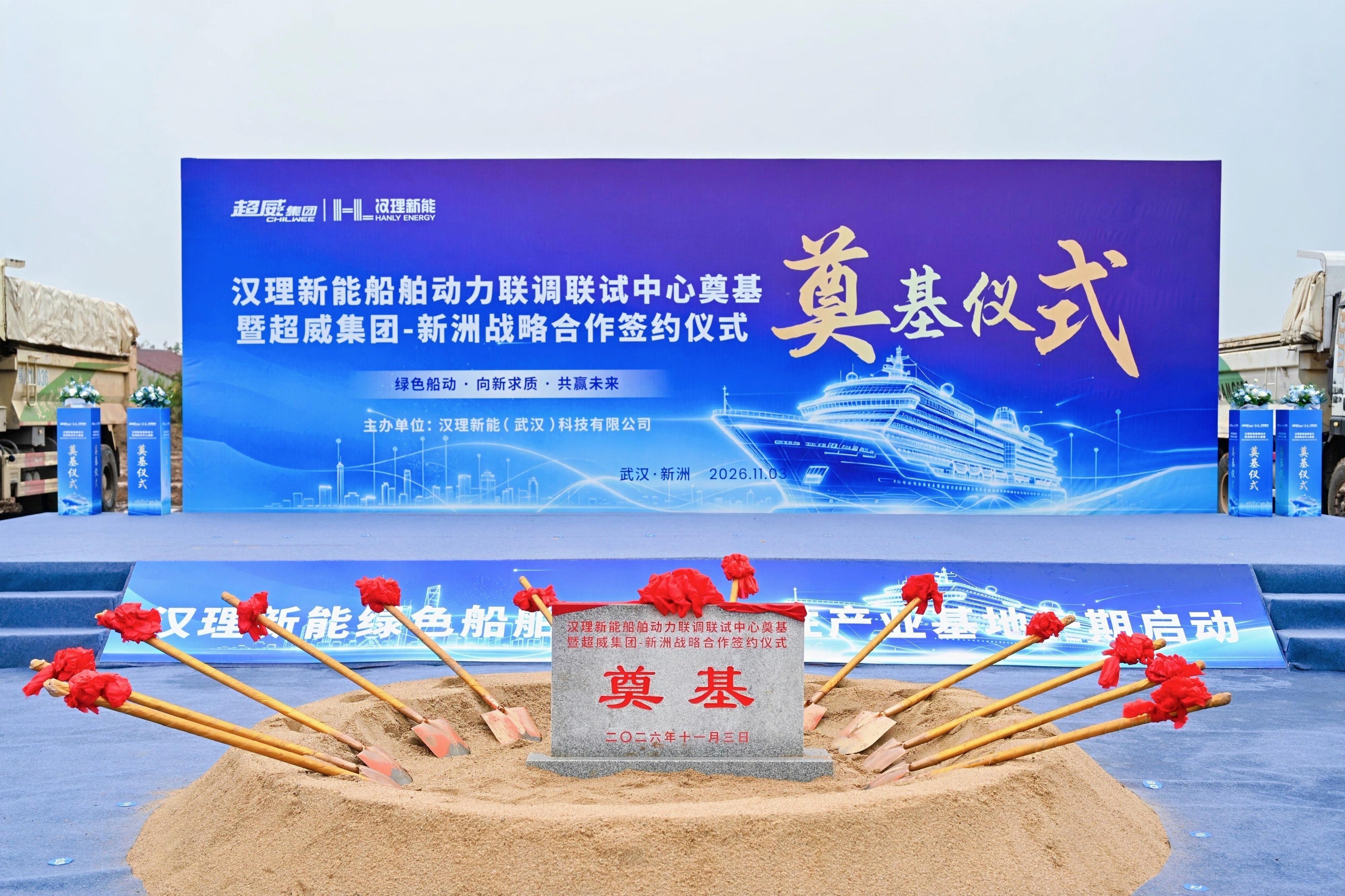
The project was officially announced on October 17th during the 80th Anniversary Conference for the Discipline of Naval Architecture and Ocean Engineering at Wuhan University of Technology. This groundbreaking marks the transition of the project from cooperative agreement signing to the physical construction phase.
According to reports, the base will cover multiple energy coupling power systems, including pure electric, hybrid, hydrogen, ammonia, methanol, and natural gas. It will consist of three main platforms: system design, hardware-in-the-loop simulation testing, and onshore integrated testing, enabling full-chain testing of fuel skid-mounted systems, generator sets, battery packs, main power distribution systems, and power loads. This will facilitate verification under all operating conditions and enable proactive risk investigation. In addition to single-machine tests, the base can also place the entire power system in a simulated ship operating environment to verify its real-world performance under complex sea conditions, temperature changes, and load fluctuations.
The "bottleneck" in the industrialization of green intelligent ships lies in the engineering verification phase. No matter how optimal the laboratory prototype data is, it cannot be directly installed on a ship for water deployment without undergoing bench verification and onshore integrated testing. Previously, Hubei-based shipbuilding companies often had to transport equipment to other provinces for such verifications, which was time-consuming and labor-intensive, thus hampering the efficiency of research and development iterations.
Wuhan is a national hub for the green intelligent ship industry, accounting for 80% of China's green intelligent ship research and design and 62% of the country's ship electric propulsion system components. However, before, it still lacked a centralized and open public platform for multi-energy coupling and full-chain system-level pilot verification. The new pilot test base in Xinzhou, Wuhan, precisely addresses this gap.
After the base is completed, green ship power systems in Hubei province and the middle and lower reaches of the Yangtze River will be able to undergo system-level validation in Wuhan before being deployed in actual ships. This is expected to further shorten the research and development iteration cycle and provide localized engineering verification support for the green transformation of inland waterway transportation.
-
A 2-megawatt multi-energy land-based commissioning and testing platform established in Wuhan.4015
-
China Communications Construction Mechanical & Electrical Bureau creates a smart digital commodity storage and transportation hub in the Bohai Sea Rim.3900
-
The waters of Guangxi flow endlessly, the canal leads to the ocean.4343
-
Minjiang Dongfengyan Hydropower Hub Ship Lock enters construction phase for navigation.3533
-
Tianjin Xingang Maritime Safety Administration improves the "Four-Grasp Closed-Loop" mechanism to prevent the risk of open-flame operations on ships in the port.4061