Yangshan Port Maritime Implements Multiple Measures to Ensure the Safe Departure of Thousands of Fishing Vessels
At 12:00 on September 16, as the seasonal fishing moratorium in the East China Sea officially ended, nearly a thousand fishing boats departed from the Zhoushan waters, heading to the Yangtze River estuary fishing grounds. The Yangshan Port Maritime Bureau made early preparations, utilizing intelligent supervision, time-segmented traffic control, and on-site inspections to fully ensure the safety and smoothness of the waters during the fishing season.
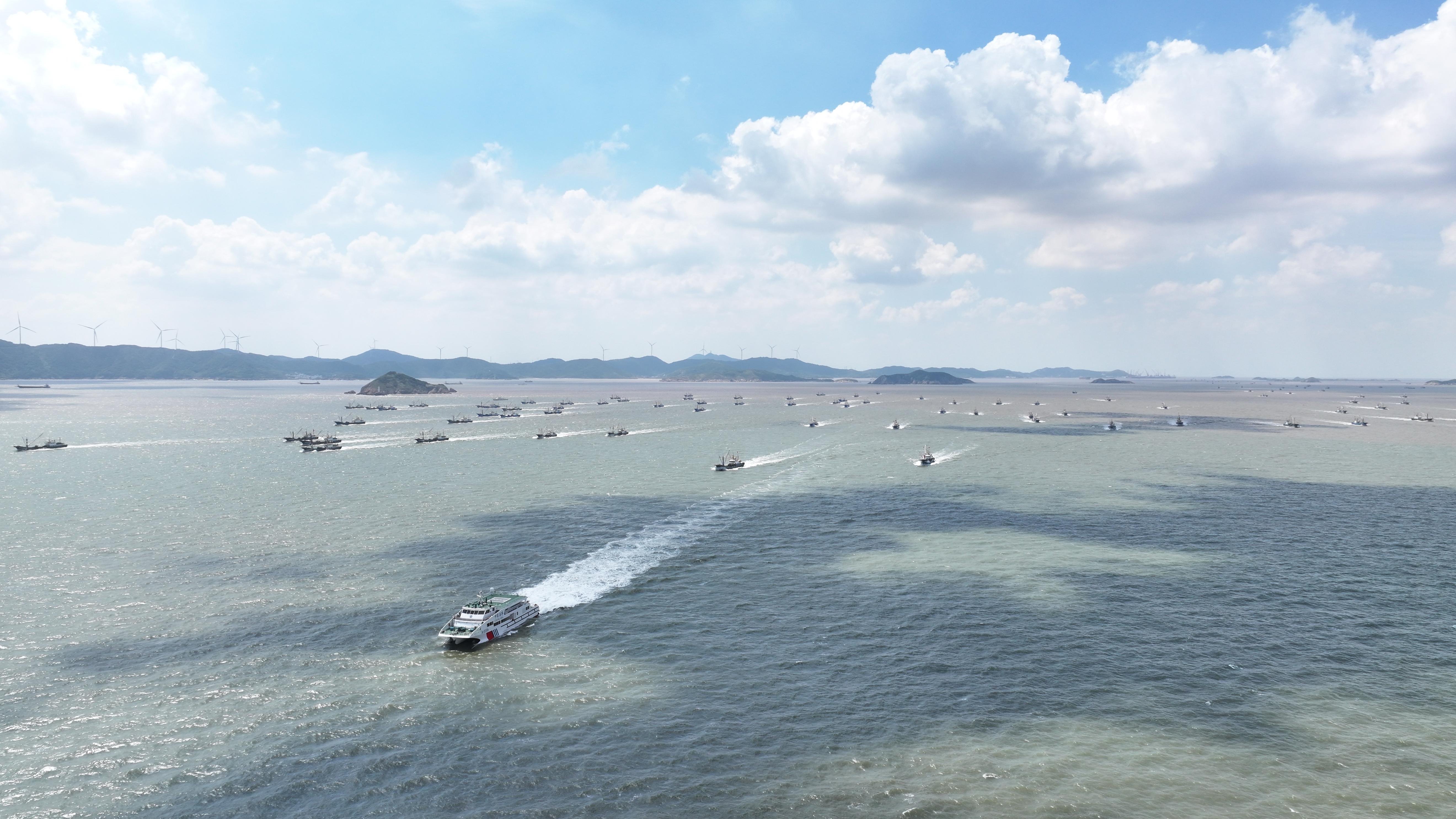
With the end of the fishing moratorium, a large number of fishing boats sounded their horns and set sail, forming a grand fleet heading into the deep blue sea. The Yangshan jurisdiction waters immediately experienced a peak in fishing boat departures. Facing a complex navigation environment, the maritime department collaborated with the fisheries administration before the fishing season to conduct safety lessons at the docks, titled "Safety First for Fishing Operations." They also used digital channels such as VTS Genie and WeChat groups to precisely deliver safety warnings, enhancing crew awareness from the source. Additionally, joint patrols were conducted to clear obstructive fishing nets, purifying the navigation water environment.
In terms of intelligent supervision, the Yangshan Port Maritime Bureau relied on a dedicated platform for commercial and fishing vessel inspections, integrating multiple technological tools such as VTS Genie, AIS, and CCTV to implement 24-hour uninterrupted dynamic monitoring of commercial and fishing vessels in the jurisdiction. During peak periods of fishing boat departures and dense intersections of commercial and fishing vessels, the VTS center broadcasted navigation warnings via VHF high frequency, providing "point-to-point" precise reminders to commercial vessels entering dense waters and guiding them to avoid collisions reasonably. Furthermore, the maritime department deepened information interconnectivity with Zhoushan fisheries administration, achieving data sharing and coordinated management.
For core navigation waters, the maritime department scientifically deployed multiple patrol boats for fixed-point guarding and dynamic inspections, while coordinating high-power emergency tugboats to be on standby. To minimize the impact of the peak fishing boat departures on main navigation channels, the maritime department implemented time-segmented refined traffic control, guiding mainline container vessels to adjust their schedules and stagger their passage times. On the opening day of the fishing season, the main leader of the Yangshan Port Maritime Bureau led a team to the frontline for direct command, with the entire bureau strictly enforcing a 24-hour duty system to ensure rapid on-site response.
-
The waters of Guangxi flow endlessly, the canal leads to the ocean.4333
-
Minjiang Dongfengyan Hydropower Hub Ship Lock enters construction phase for navigation.3523
-
Harnessing Water to Thrive, Writing a New Chapter; Steering Forward with Determination, Leading the Tide—Written on the Occasion of the 75th Anniversary of the CCCC Water Transport Planning & Design Institute3976
-
Tianjin Xingang Maritime Safety Administration improves the "Four-Grasp Closed-Loop" mechanism to prevent the risk of open-flame operations on ships in the port.4048
-
Guangzhou Seafarer Competency Assessment Demonstration Center welcomes its first nationwide sea-going crew competency re-examination.3683