The Seminar on Empowering New Productive Forces in Marine Oil and Gas Engineering Equipment Was Held in Fuzhou.
On October 16, the 2026 World Maritime Equipment Conference was inaugurated in Fuzhou. That afternoon, one of the accompanying activities of the conference—the Seminar on Empowering New Quality Productivity of Marine Oil and Gas Engineering Equipment—was held.
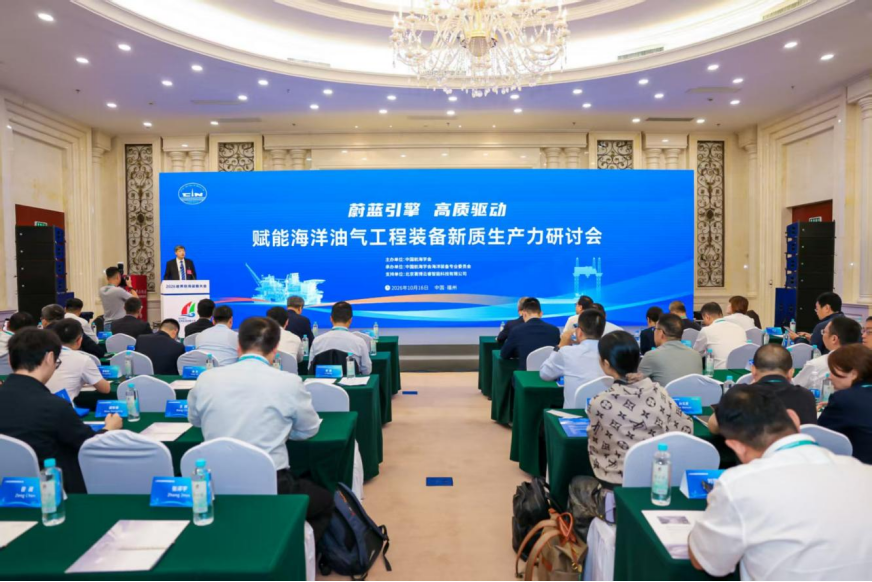
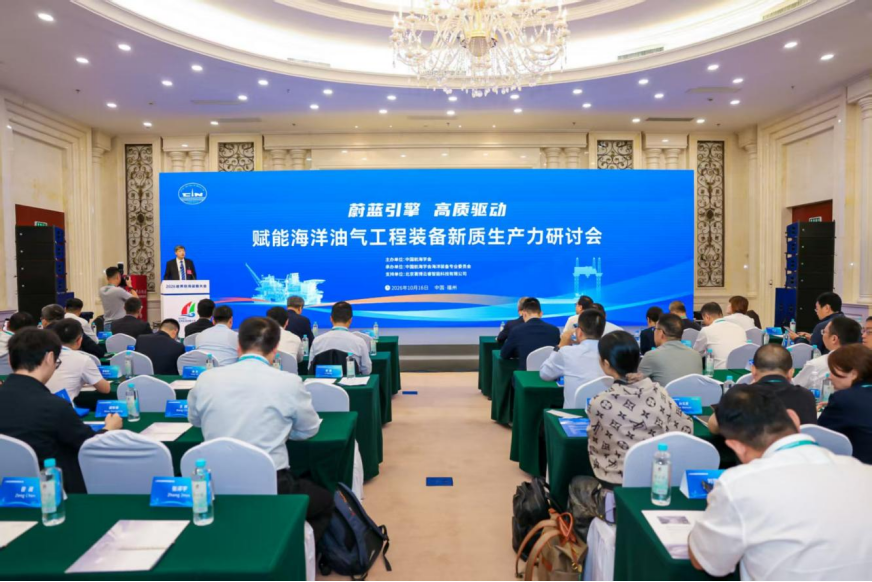
This seminar, themed “Blue Engine, Driving High Quality,” was hosted by the Chinese Society of Navigation and organized by the Marine Equipment Professional Committee of the Chinese Society of Navigation. Yan Xinping, President of the Chinese Society of Navigation and Professor at Wuhan University of Technology, and Liu Huixiong, Member of the Party Leadership Group and Vice Chairperson of the Fujian Association for Science and Technology, attended and delivered speeches. Tang Haibo, Party Secretary and General Manager of the Shipping Division of CNOOC Oilfield Services Co., Ltd., presided over the meeting.
Yan Xinping stated that the Chinese Society of Navigation, in collaboration with CNOOC Oilfield Services Co., Ltd., jointly promotes the establishment of the Marine Equipment Professional Committee, seizes the initiative in deep and distant-sea development and the bottom line of energy security, and serves the construction of a maritime powerhouse. In the future, the Marine Equipment Committee must fully leverage its functions as a bridge, think tank, collaborative platform, and talent hub, combining the academic strengths of the Chinese Society of Navigation, the engineering strengths of enterprises, and the research strengths of universities and institutions to create a strong synergy to promote the development of new quality productivity in marine equipment.
Liu Huixiong stated that 2026 marks the beginning of the “Fifteenth Five-Year Plan,” and Fujian is accelerating the construction of the "Maritime Fujian," focusing on marine emerging industries as the core track for cultivating new quality productivity. Marine oil and gas engineering equipment is a crucial support for deep and distant-sea energy development and national energy security and aligns closely with the development direction of Fujian’s marine industry. He hopes to take this seminar as an opportunity to deepen exchanges and collaboration with colleagues from various sectors, streamline the "collaborative chain of societies providing platforms, talents driving synergy, and industrial implementation," jointly explore innovative paths for marine oil and gas equipment, and promote the advancement of Fujian’s marine industry toward deep-sea, distant-sea, and high-end development.
During the keynote speech segment, experts and scholars from upstream and downstream sectors of the marine oil and gas engineering equipment industry chain exchanged views comprehensively and conducted in-depth discussions on the development of marine equipment, sparking ideas and forming a consensus on development.
Zhang Qingwen, Vice President of China Classification Society (CCS), introduced the current development of domestic and international floating wind power and offshore oil and gas clean power substitution industries. He pointed out that providing power for deep and distant-sea oil and gas platforms through floating wind power is an essential path for the green transformation of marine oil and gas. He called on the industry to move from single-unit demonstration to large-scale application, improve the standard system, upgrade multi-energy complementary microgrids, promote the independence of simulation software, and achieve a digital and intelligent operation and maintenance revolution. He also emphasized that the China Classification Society would continue to tackle frontier technology and develop standards to support the integration of floating wind power and high-quality development of the marine oil and gas industry.
Jin Xin, Chief Dispatcher of the Operations Coordination Department of CNOOC (China) Co., Ltd. Tianjin Branch, emphasized that during the “Fifteenth Five-Year Plan,” marine oil and gas equipment will focus on five main directions: deepwater capability, autonomy, greening, digitalization, and deep-sea expansion. A new quality productivity cultivation system featuring “one core with four wings”—with technology breakthroughs as the core, and supported by digitization, green development, industrial clusters, and talents—needs to be built. He stressed the importance of conquering key core technologies to strengthen marine equipment as a significant national asset and solidify new quality productivity as a new engine.
Du Pengfei, Deputy Director of the Energy Technology Department of Shanghai Ship Research and Design Institute, stated that the industry's central challenge is creating more efficient, green, and safe offshore vessels. He suggested breakthroughs can be made by focusing on four technical directions: numerical simulation to analyze hull designs, dynamic positioning, and operational efficiency; digital technology to establish integrated three-dimensional design, online collaborative design, and digital delivery platforms enabling shipowners to participate early in vessel design and to support post-operational maintenance through real ship model data; green technologies such as various hybrid electrical systems and dual-fuel LNG and ammonia to reduce carbon emissions; and intelligent technologies to optimize vessel trim, route planning, implement intelligent engine rooms, and smart navigation. Collaborative efforts in multiple technologies are essential to resolving research challenges in offshore vessel development.
Li Wenhua, a specially-appointed professor under the national high-level talent program at Dalian Maritime University, stated that marine equipment is a vital foundation for marine development and utilization, sitting at the core of the value chain of the marine industry. As China's deep-sea resource development gradually moves from nearshore to distant waters, the complex marine environment and high-intensity operational demands place higher requirements on the safety, reliability, and autonomy of marine equipment. Building an autonomous, controllable, and efficiently coordinated marine equipment system is an urgent strategic need to enhance deep and distant-sea resource development capabilities, safeguard national maritime rights, and support the construction of a maritime superpower.
Ma Fan, Director of the Green Innovation Center at Hubei Donghu Laboratory, introduced that the core equipment of China's marine oil and gas engineering equipment integrated power systems currently relies heavily on imports, which poses risks of supply disruptions, high costs, and challenges in meeting green and low-carbon development needs. Leveraging the advanced technological leadership of domestic integrated power systems, he emphasized the necessity of vigorously advancing the localization of integrated power systems for search and rescue vessels.
Zhou Wenqing, Director and first-level researcher at the Dangerous Goods and Pollution Prevention Department of the Fujian Maritime Safety Administration, stated that “green and intelligent symbiosis” must first mean “collaborative symbiosis.” He suggested that the adjustment of the energy supply structure for the green engines of high-end marine equipment could be implemented in stages: promoting fuel transitions gradually from shore power and LNG in the short term, to methanol in the medium term, and ammonia and hydrogen in the long term. He called on all industry players to act collaboratively and jointly forge a green engine for high-end equipment by building innovative green energy alliances, advancing typical demonstration projects, and establishing a baseline for secure development.
During the seminar, five main research directions for marine oil and gas equipment were shared, and a ceremonial launch was held for the application of permanent magnet motor technology in OSVs (Offshore Support Vessels).
-
The Seminar on Empowering New Productive Forces in Marine Oil and Gas Engineering Equipment Was Held in Fuzhou.3140
-
Fighting "foreign lawsuits" well is the essential skill for Chinese companies going global.4417
-
The International Training Program on Green and Low-Carbon Shipping Technologies for the Belt and Road Initiative Kicks Off3587
-
The Red Boat Reflects the Original Aspiration, the Azure Writes Responsibility — China Classification Society Zhejiang Branch Guides High-Quality Development with High-Quality Party Building4849
-
Anhui's first reuse and expansion project, the Chaohu Ship Lock, has been completed and opened for navigation.3432